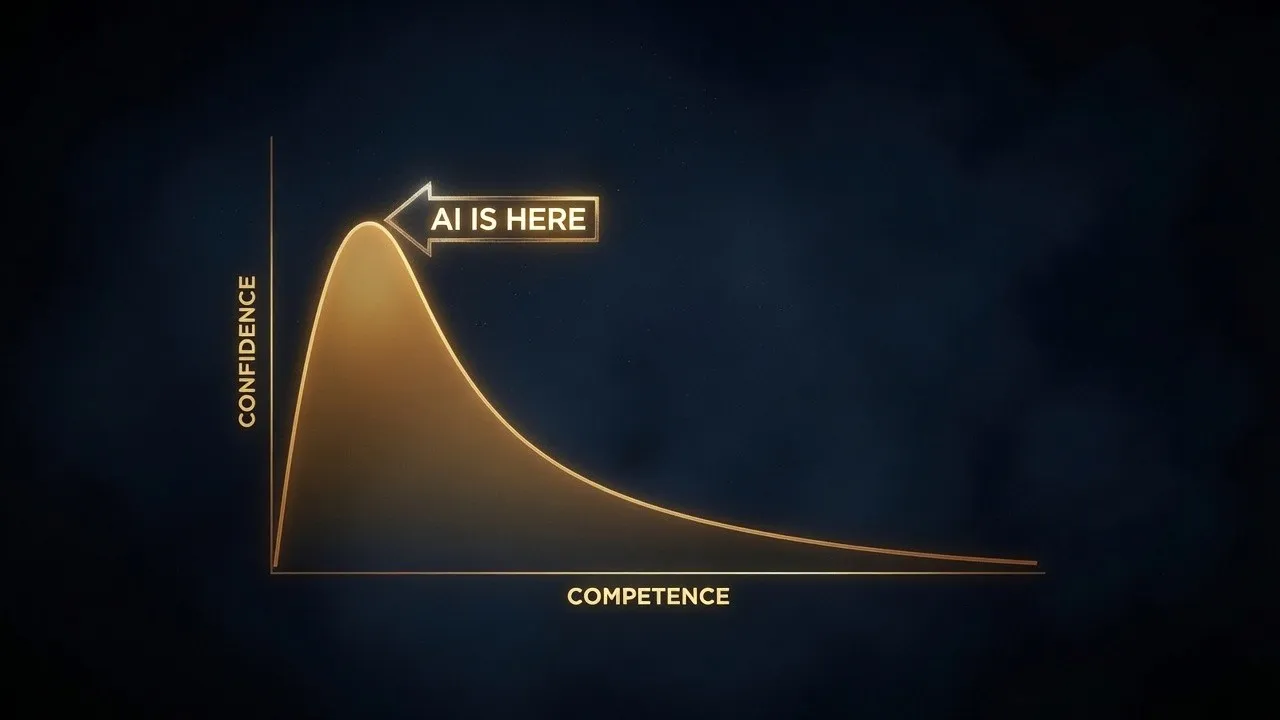
What happens when you hand AI to someone without the judgment to question it?
In Part 1, we named what's walking out your front door. The shortcuts. The workarounds. The judgment calls that happen automatically because someone spent twenty years learning exactly when to bend the rules and when to hold firm.
Now here's the illusion being sold to replace it.
The technology industry has been selling leaders what I call the solution du jour for decades. The one tool that will finally fix everything. MRP. MRP II. ERP. CRM. Workflow automation. And now AI.
Each arrives with the same promise and the same fine print: results not guaranteed without the right people to make it work.
Today's golden goose — AI — produces average results at best. And here's why: it averages everything it was trained on — the brilliant, the mediocre, and the just plain wrong — and serves it back to you with complete confidence.
Confidence without competence doesn't waver. How can it? It doesn't know what it doesn't know. It delivers the answer the same way whether the underlying data was brilliant, mediocre, or just plain wrong. Same tone. Same authority. Same enthusiasm.
Dunning-Kruger at industrial scale. Paid for by the token.
Here's where the real damage happens.
The untrained user has no signal that what they received is the middle of a distribution that included bad data. Decisions get made at speed — because speed is part of the pitch. Bad answers get confirmed — because most people ask questions shaped by what they already believe. That's confirmation bias, and AI is exceptionally good at feeding it.
The output validates the assumption. The assumption hardens into a decision. The decision gets made with more confidence than it ever deserved.
And then the most insidious damage of all: the Answer Grape says that's not how this actually works here. The leader shows them the AI output. The Answer Grape goes quiet.
The institutional knowledge that took twenty years to develop just lost to the confident average.
This is what happens when you hand today's golden goose to someone without the judgment to question it.
The real opportunity isn't replacing your Answer Grapes with technology. It's capturing their guidance — their judgment, their context, their hard-won instincts — and using that to shape how the tools are applied.
The Answer Grape doesn't have to love the technology. They just have to inform it.
That's where the trainer becomes essential — building the feedback loop that connects what your best people know to what your tools actually deliver.
AI doesn't have a hallucination problem. It has a character problem. And you can't partner your way to good judgment without the competence to know the difference.
The sequence that fixes it. Part 3 →